


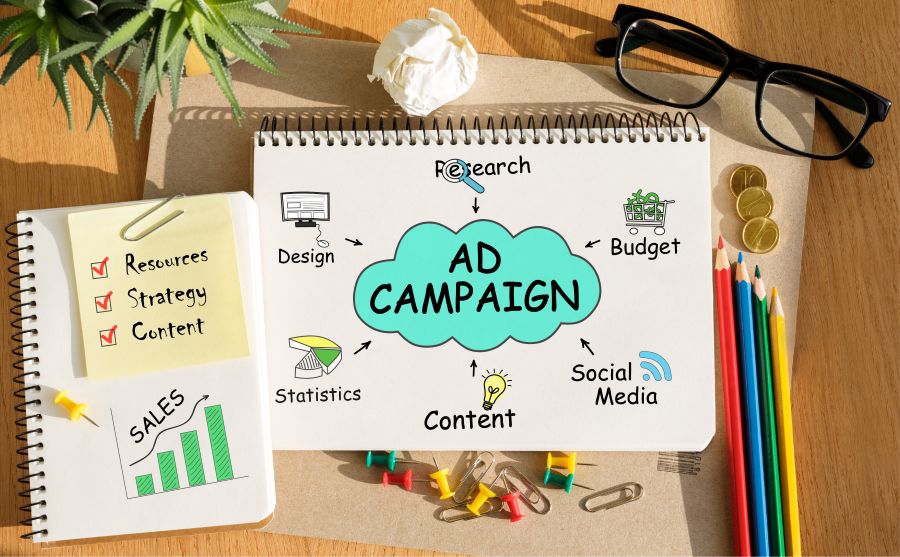
Every advertising campaign is born with a clear goal: to attract attention, build trust, and most importantly, deliver results. Yet, between rushed strategies, wrong targeting, and poor data analysis, even experienced companies can make mistakes that wipe out weeks of planning and investment.
Understanding the five most common mistakes that undermine a campaign’s performance is essential for anyone working in digital marketing or launching an online business project. Avoiding them means saving resources and building communication strategies that are more effective and consistent with business objectives.
1. Lack of a clear strategy
The first step toward the failure of an advertising campaign is starting without a plan. Many brands focus on aesthetics — design, message tone, platform — but overlook the importance of a solid strategy. Without clear objectives, every action becomes scattered, and results are rarely measurable.
An effective strategy must answer three key questions: who we want to reach, what we want to communicate, and why the audience should care. Only by defining these foundations can a campaign become coherent, trustworthy, and conversion-driven.
A common mistake is thinking that simply “being online” guarantees visibility. On the contrary, visibility must be built with measurable goals and an integrated plan across social media, search engines, and display channels. Without direction, even the most creative idea risks getting lost in the digital noise.
2. Wrong or poorly defined target audience
An advertising campaign succeeds when it speaks to the right person at the right time. However, many businesses make the mistake of defining their audience too broadly or relying on outdated data. The result is a message that reaches people who have no interest in the product or service being promoted.
Understanding your audience means more than analyzing age or location; it involves identifying needs, habits, and motivations that drive purchasing behavior. Modern analytics tools make it possible to build personalized audiences based on real behaviors and specific interests. Ignoring these tools means wasting budget and drastically reducing return on investment.
Another common error is not testing different versions of an ad. Small adjustments in visuals, tone, or calls to action can significantly change engagement levels. Success comes through a continuous process of analysis and optimization, not by chance.
3. Ineffective message and poor visual consistency
Even the most detailed strategy can fail if the message isn’t clear or if the visual elements don’t match the brand identity. One common mistake is trying to say too much, cramming in unnecessary details or confusing slogans. Today’s audiences decide within seconds whether a piece of content is worth their time — so every word must count.
An effective message combines simplicity with value. It’s not enough to show a product; you need to explain why it matters to the customer. The most successful campaigns tell a story and convey an experience rather than just promoting a sale.
Visuals also play a crucial role. Inconsistent colors, mismatched fonts, or generic images can damage a brand’s credibility. In marketing, aesthetics are a form of communication. A clean, coherent design projects professionalism and strengthens trust in the message.
4. Lack of monitoring and continuous adaptation
Another mistake that destroys an advertising campaign is the lack of proper monitoring. Many companies launch ads and stop analyzing them afterward, assuming that results will just come in. In reality, without constant tracking, it’s impossible to know whether the strategy is working.
A successful campaign requires continuous adaptation. Reviewing conversion rates, click-throughs, impressions, and costs allows marketers to correct issues early. Even a few days’ delay can lead to significant budget waste.
Artificial intelligence has made this process far more accurate. In this context, Across, the digital company leader in digital marketing, designs high-performing campaigns, including SEO packages and tailored strategies to launch client websites. Thanks to its AI agents, the company integrates intelligent systems that optimize performance in real time, analyze audience behavior, and enhance campaign results through predictive logic.
Smart monitoring supported by advanced technologies allows companies not only to react to data but also to anticipate it, turning campaigns from static initiatives into dynamic growth tools.
5. Neglecting the post-click experience
Many believe that the success of an advertising campaign ends with the click on the ad. Nothing could be further from the truth. Driving users to the right page is only half the work — the other half lies in what happens afterward.
A frequent mistake is directing users to landing pages that are slow, unclear, or not mobile-friendly. In such cases, even the best ad loses its effectiveness. The post-click experience must be smooth, consistent with the ad’s message, and designed to guide users toward a specific action — whether that’s filling out a form, making a purchase, or subscribing to a newsletter.
Another critical issue is the absence of a well-structured funnel. Each step, from first impression to conversion, should be designed to guide the visitor and make decision-making effortless. When users encounter friction or inconsistency, trust breaks and the conversion opportunity vanishes.
An advertising campaign doesn’t end with a click; it continues in the relationship built with the customer. Focusing on this aspect helps turn a casual visitor into a lasting connection, creating a genuine competitive advantage.
Avoiding these five mistakes doesn’t guarantee instant success, but it lays the foundation for a solid, consistent, and measurable advertising campaign. A clear strategy, precise targeting, effective messaging, constant monitoring, and a seamless post-click experience form the pillars of any winning project.
In digital marketing, presence alone isn’t enough — what matters is strategy, analysis, and ongoing improvement. Only brands that combine creativity, technology, and data can turn advertising into a true driver of growth.